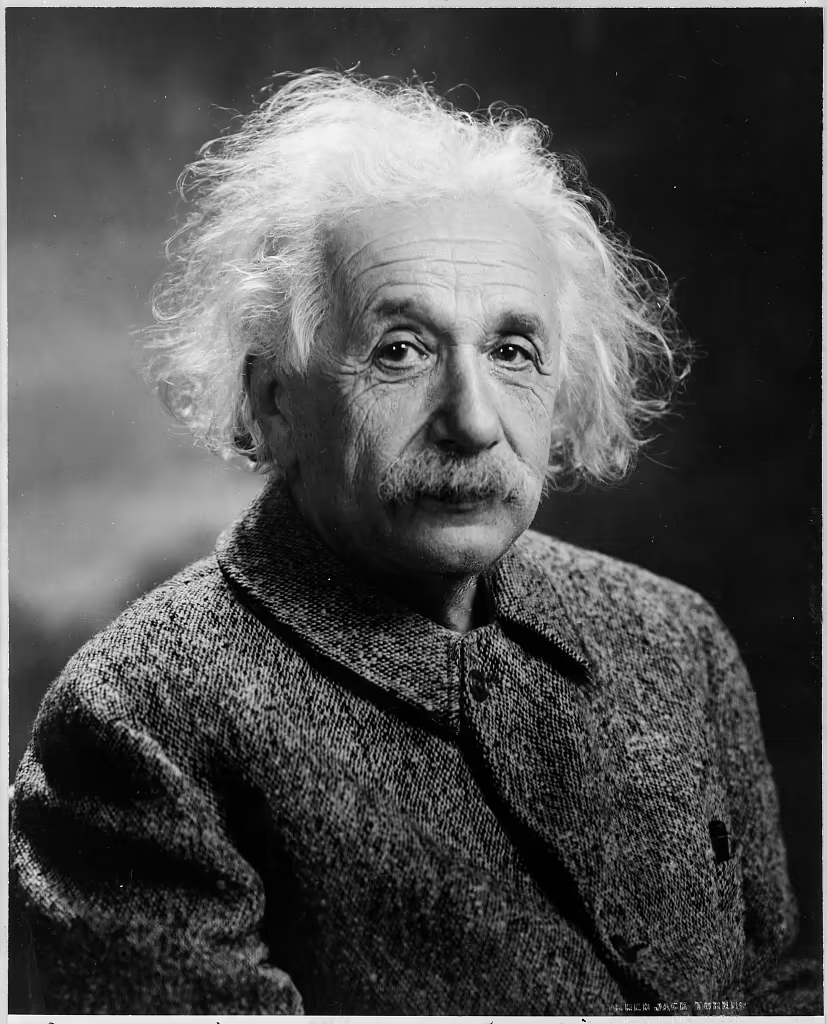
Einstein is one of the rare people whose face can stand in for an entire field of knowledge. The wild white hair, the heavy sweater, the faraway gaze: together they have become a global shorthand for “genius.” That image is real, but incomplete. Albert Einstein was not born as a monument. He was a stubborn student, a young employee working outside academia, a theorist willing to question basic assumptions, a refugee pushed from Europe by Nazism, and a public figure who spoke about war, race, freedom, and responsibility.
01 / BEFORE THE ICON
NO, HE DIDN'T
FAIL MATH.
The most repeated origin story about Einstein is also one of the least useful: that a struggling student failed mathematics and later shocked everyone by becoming a physicist. The truth is more interesting. Born into a German Jewish family in Ulm in 1879, Einstein showed an early fascination with geometry and physical puzzles. He disliked rigid schooling and authority, but he was already working through advanced mathematics while still young. His rebellion was against the classroom’s method, not the subject.
After studying in Switzerland, he had trouble securing the university position he wanted. In 1902 he joined the Swiss Patent Office in Bern. The job was not a romantic retreat from science. It required him to inspect proposals, strip complicated devices down to their essential logic, and decide whether an idea actually worked. Outside office hours, he discussed physics with friends and developed arguments that would soon change the field.
This matters because the legend of effortless genius can hide what discovery looks like. Einstein read deeply, debated intensely, made mistakes, revised his thinking, and worked within a scientific community. His originality did not emerge from nowhere. It came from taking familiar problems seriously enough to ask whether their most basic assumptions were wrong.
Bern also gave him intellectual company. The small discussion circle he called the Olympia Academy read physics and philosophy, argued over first principles and treated serious inquiry as a shared practice rather than a credential. The name was playful, but the habit was important. Einstein’s later celebrity encouraged the myth of the isolated mind; his formative years show conversation, correspondence and criticism doing essential work.
The patent-office story is therefore neither a fairy tale about an outsider defeating experts nor proof that institutions do not matter. Einstein had formal scientific training, followed the literature and wanted an academic career. What the office gave him was a livelihood, contact with technical claims and a degree of distance from university hierarchy. His route was unusual. It was not unprepared.
THE BREAKTHROUGH WASN'T A MAGIC FORMULA.
— THE WIKIPLOTS TAKE
IT WAS A BETTER QUESTION.
02 / THE BREAKTHROUGH YEARS
FOUR IDEAS THAT
RESET PHYSICS.
In 1905, often called his “miracle year,” Einstein published a cluster of papers with extraordinary reach. One proposed that light could behave as discrete packets of energy, helping explain why light striking certain metals releases electrons. Another used the random motion of tiny particles in liquid to strengthen the case for atoms and molecules, which were still disputed by some scientists. A third introduced special relativity. A fourth established the relationship between mass and energy that became famous as E=mc².
LIGHT QUANTA
Explains the photoelectric effect by treating light as packets of energy—the work later singled out by the Nobel Prize.
BROWNIAN MOTION
Shows how the jittery motion of tiny particles can provide measurable evidence that atoms and molecules are real.
SPECIAL RELATIVITY
Rebuilds ideas of space and time around two principles: physics works consistently in uniform motion, and light keeps the same speed.
GENERAL RELATIVITY
Recasts gravity as the geometry of spacetime, giving physics a new way to describe planets, stars, light, and the universe itself.
Special relativity begins with a surprisingly severe discipline: stop assuming that time and distance are identical for every observer. If the laws of physics work the same for observers moving steadily relative to one another, and if the speed of light is constant, then measurements of time and space must depend on motion. Clocks can disagree. Lengths can change along the direction of travel. Events that seem simultaneous to one observer may not be simultaneous to another.
E=mc² emerged from that framework. It says mass is a concentrated form of energy, linked by the speed of light squared. The compact equation is not a general instruction for building a bomb, as pop culture sometimes makes it seem. It expresses a deep equivalence that applies across nuclear physics and the energy processes of stars. Its fame is deserved, but it represents only one corner of Einstein’s work.
03 / A NEW SHAPE FOR GRAVITY
SPACE AND TIME
LEARNED TO BEND.
Special relativity dealt with steady motion. Gravity demanded something more. Over roughly a decade, Einstein worked toward a theory that connected acceleration, gravity, space, and time. The result, completed in 1915, was general relativity. In this picture, gravity is not simply an invisible force pulling across empty space. Matter and energy shape spacetime, and that geometry guides how matter and light move.
HOW TO CURVE.CURVED SPACETIME TELLS
MATTER HOW TO MOVE.
The theory made predictions that could be checked. It accounted for a subtle feature of Mercury’s orbit that Newtonian physics had not fully explained. It also predicted that the Sun’s gravity would deflect the path of starlight. During a solar eclipse in 1919, teams led by British astronomer Arthur Eddington made observations consistent with that prediction. Newspapers turned the result into an international event, and Einstein became a celebrity almost overnight.
Science did not stop in 1919. General relativity has been tested repeatedly, and its effects are part of technologies people use without thinking about Einstein. Satellite navigation systems must account for differences in clock rates caused by motion and gravity. Astronomers use relativity to understand dense stars, black holes, gravitational lenses, and the evolution of the universe. In 2015, a century after the theory, scientists directly detected gravitational waves—ripples in spacetime from accelerating massive objects.
The eclipse episode also offers a lesson in how science becomes news. The 1919 observations were difficult, and later historians have examined their uncertainties and the way results were selected and interpreted. The broad conclusion—that gravity bends light—survived far more precise tests. But the instant newspaper story of one expedition “proving” a lone genius is too neat. Evidence becomes durable through repetition, improved instruments and the possibility that a result could fail.
04 / THE PRIZE PEOPLE MISREMEMBER
THE NOBEL WASN'T
FOR RELATIVITY.
The Nobel Prize in Physics for 1921 recognized Einstein for his services to theoretical physics, especially his discovery of the law of the photoelectric effect. The prize was announced and presented in 1922 after the award had been reserved for a year. Relativity dominated Einstein’s public reputation, but the committee focused on work with clearer experimental support at the time.
That choice captures one of the most productive tensions in Einstein’s career. He helped launch quantum theory by taking light quanta seriously, yet he later objected to the standard probabilistic interpretation of quantum mechanics. His long exchanges with Niels Bohr were not a simple contest between a clever winner and a stubborn loser. They forced physicists to state more precisely what the theory claimed about measurement and reality. Even Einstein’s resistance helped sharpen the questions.
05 / EXILE AND CITIZENSHIP
WHEN SCIENCE MET
THE POLITICS OF SURVIVAL.
Einstein’s life was reshaped by European fascism. He was internationally famous, Jewish, politically outspoken, and a target of nationalist attacks that dismissed modern physics as “Jewish science.” When Adolf Hitler came to power in 1933, Einstein did not return to Germany. He joined the newly created Institute for Advanced Study in Princeton, New Jersey, and remained there for the rest of his life. He also worked to help Jewish scholars and other people threatened by the Nazi regime.
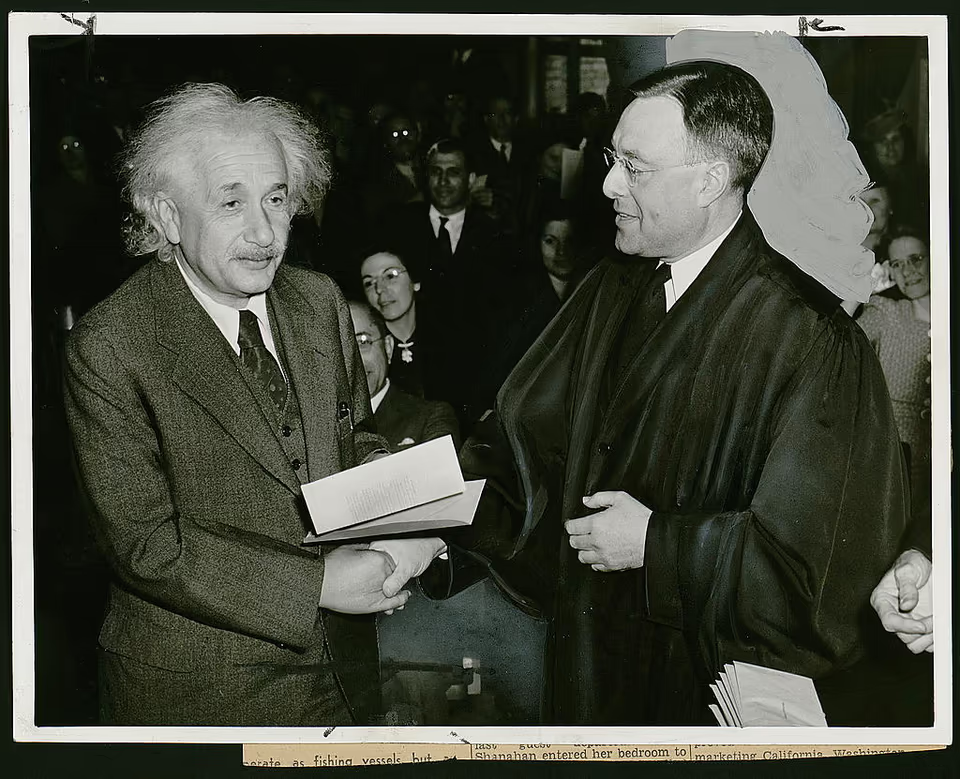
In 1939, after physicists Leo Szilard and Eugene Wigner warned him that uranium research could make a powerful new weapon possible, Einstein signed a letter to President Franklin D. Roosevelt. It urged the United States to pay attention to nuclear research and the risk that Nazi Germany might pursue a bomb. The letter helped move the issue into government, but Einstein did not work on the Manhattan Project and did not invent the atomic bomb.
After Hiroshima and Nagasaki, he supported nuclear arms control and served as chairman of the Emergency Committee of Atomic Scientists. His position evolved with the danger he perceived: the pacifist who had accepted the need to resist Nazi aggression became a prominent advocate for international cooperation, disarmament, and structures strong enough to prevent another world war. The story is not one of perfect consistency. It is a record of someone trying to carry moral principles through catastrophic circumstances.
06 / THE PUBLIC EINSTEIN
GENIUS DIDN'T STAY
INSIDE THE LAB.
Einstein’s public commitments reached beyond war and nuclear weapons. In the United States he spoke against racism and segregation. He worked with singer and activist Paul Robeson on an anti-lynching campaign, supported civil-rights organizations, and formed friendships with prominent Black Americans. When the celebrated contralto Marian Anderson was refused lodging in segregated Princeton, Einstein welcomed her into his home.
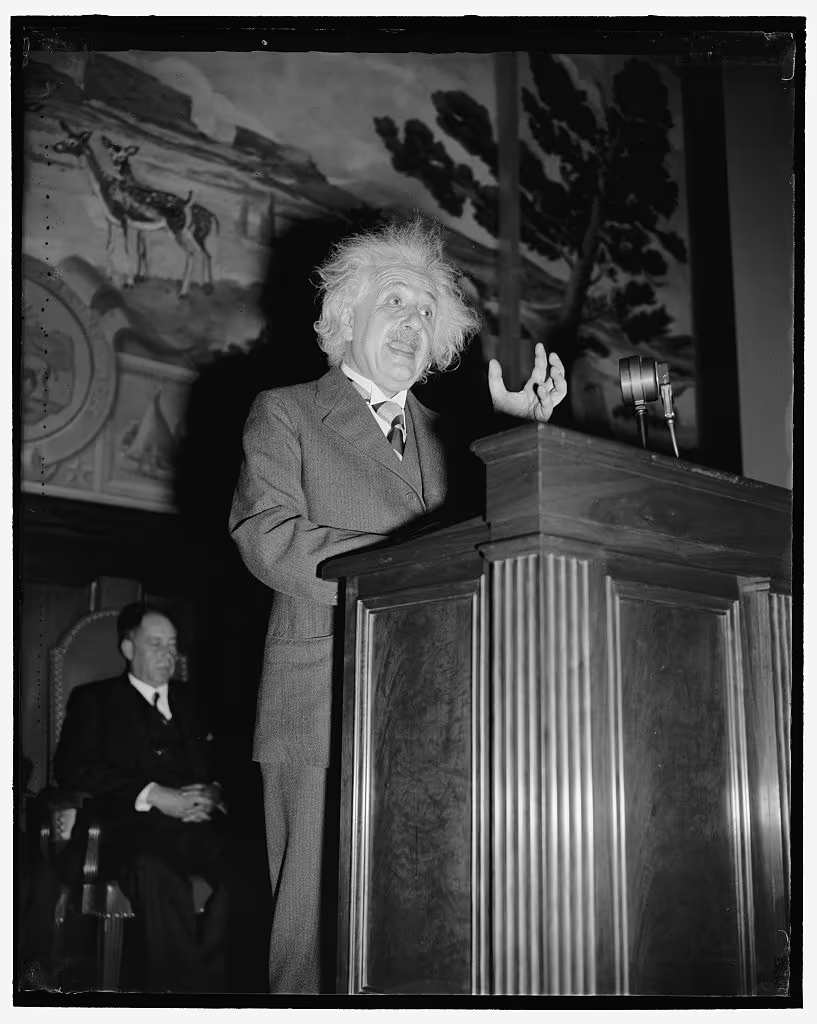
He also defended civil liberties during the Red Scare, arguing that people targeted by congressional investigations should resist intimidation. These positions were not risk-free in the political climate of the early Cold War. They remind us that Einstein’s moral authority did not come only from being famous. He chose to spend some of that fame on causes that were controversial and urgent.
Princeton made the contradiction especially immediate. Einstein had escaped a regime that classified people through racist law, then settled in an American town shaped by segregation. The Smithsonian’s account places his civil-rights activity beside his physics rather than treating it as a footnote: work with Paul Robeson against lynching, hospitality to Marian Anderson after a hotel refused her lodging, and public opposition to racial inequality.
That record does not make Einstein the center of the Black freedom struggle. Robeson, Anderson, W. E. B. Du Bois and the organizers of the NAACP carried risks and responsibilities that a famous white scientist did not share. Einstein’s role is more accurately understood as alliance: listening, lending a globally recognized name, contributing to organizations and refusing the convenience of silence. The distinction keeps the history proportionate while preserving the significance of his choices.
Still, a responsible portrait should resist turning Einstein into a flawless secular saint. His personal relationships could be difficult. His scientific judgment, while extraordinary, was not automatically correct. He spent decades pursuing a unified field theory without reaching the result he wanted, and he remained deeply dissatisfied with quantum mechanics as most physicists came to understand it. Genius describes a capacity; it does not erase limits, blind spots, or unfinished work.
07 / WHY HE STILL MATTERS
THE LEGACY IS MORE
THAN E=mc².
Einstein changed the questions physics could ask. His work connected energy and matter, gave light a quantum dimension, made space and time dynamic, and transformed gravity into geometry. The consequences appear in solar cells and light sensors, particle physics, cosmology, satellite navigation, black-hole research, and the study of gravitational waves. Some applications arrived decades after the theories; others are still unfolding.
His broader legacy is a method of attention. Einstein was unusually good at noticing when an everyday assumption—about clocks, motion, light, or falling—had been smuggled into a problem as if it were a law of nature. He built thought experiments that removed the clutter and exposed the contradiction. Then came the hard mathematics, consultation, correction, and the demand for evidence.
That is a more useful inheritance than the cartoon of a lone genius receiving answers from nowhere. Science advances through imagination, but also through communities, tools, arguments, observations, and the willingness to be wrong. Einstein’s fame can obscure that process. Look past the hair and the slogan, and his life offers something richer: curiosity with discipline, confidence with doubt, and knowledge tied—imperfectly, urgently—to responsibility.
SOURCES / READ DEEPER
Nobel Prize: Albert Einstein—Facts ↗Institute for Advanced Study: Albert Einstein in Brief ↗American Physical Society: Einstein and the Photoelectric Effect ↗Smithsonian: Albert Einstein—Physicist and Activist ↗Library of Congress: 1947 portrait and rights record ↗Library of Congress: 1940 citizenship photograph ↗Library of Congress: Einstein speaking in Washington, 1934 ↗CURIOSITY, WITH CONSEQUENCES.
One life, four dimensions, and a century of questions still unfolding.
PRINT ANOTHER STORY →