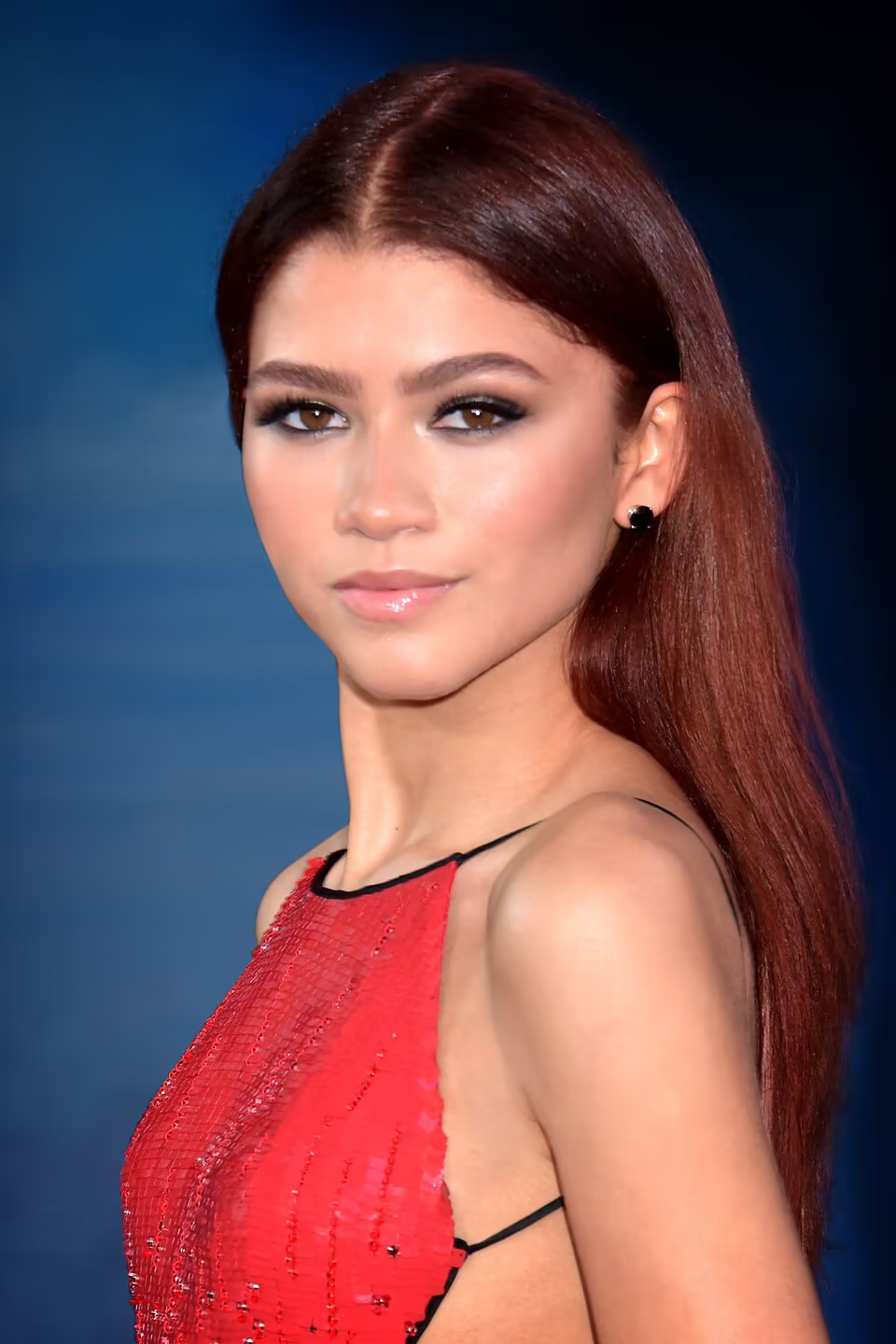
Zendaya’s career is a study in timing—not the lucky-place, lucky-moment kind, but the precise and patient kind. For more than a decade, she has made each new move feel obvious only after it works.
01 / THE BLUEPRINT
THE DISNEY PIPELINE,
REBUILT FROM INSIDE.
Child-star careers are often reduced to two scripts: repeat the first successful character forever, or reject the whole era loudly. Zendaya chose a third option. She treated early fame like an apprenticeship—learning sets, cameras, choreography, press, contracts and the strange discipline of performing while an audience watches you grow up.
That distinction matters. Shake It Up supplied visibility, but visibility alone does not create control. On K.C. Undercover, the move from performer toward creative influence became clearer. The show placed a smart Black teenage girl at the center of a family spy comedy, and Zendaya used the leverage she had earned to participate in shaping the character and the world around her.
The transition was incremental rather than theatrical. Studio films widened the scale. Producing credits widened the responsibility. Carefully spaced projects made each appearance feel like a new sentence instead of more content poured into the same feed. The through-line was not reinvention for its own sake. It was increasing authorship.

THE FLEX ISN’T BEING EVERYWHERE.
— THE WIKIPLOTS TAKE
IT’S KNOWING EXACTLY WHERE TO BE.
02 / BEFORE THE BREAKTHROUGH
THE TRAINING STARTED
BEFORE THE CAMERA.
Zendaya was born and raised in Oakland, California, and her earliest performance education grew out of a local theater ecosystem rather than a television soundstage. Her official biography describes spending much of her childhood at the theater where her mother worked. That detail matters because a theater is also a workplace: audiences arrive, seats must be filled, cues must land, costumes and lights must be ready, and a company repeats the work even when no one feels glamorous.
Dance added another kind of discipline. Choreography teaches a performer to understand rhythm across the whole body, to repeat a sequence without making it look mechanical and to stay aware of an ensemble while holding an audience’s attention. Those skills remain visible even in roles without dancing. The ability to shift weight, still the face, withhold a reaction or arrive on a beat is part of screen acting’s grammar.
Her Disney years then supplied an unusually demanding professional education. A multi-camera comedy asks for timing that can survive quick production, technical marks and a young audience’s immediate response. Promotional work asks a teenager to speak publicly about a product while still forming an adult identity. The schedule rewards reliability. None of that guarantees an artistically ambitious adulthood, but it creates knowledge about how a production functions and where a performer has—or lacks—leverage.
That is why K.C. Undercover belongs at the center of the story rather than in a disposable “before” chapter. Zendaya did not merely return as the face of another Disney series; she helped produce it. The official record describes that expanded role. The show’s premise—a Black teenage technology expert inside a family of spies—also let intelligence, action and comedy occupy the same character. Creative authority was still shared across a large television operation, but the credit marked a structural change: she was learning to shape the frame as well as perform inside it.
It is tempting to read every early decision as proof of a master plan. Careers are rarely that neat. Opportunities depend on collaborators, financing, timing, auditions and luck. What the public record does show is a pattern of accumulated skills. Theater, dance, sitcom production, music, press and fashion did not disappear when the roles became more prestigious. They became a toolkit.
03 / SIX DELIBERATE MOVES
A CAREER TIMELINE
BUILT LIKE CHAPTERS.
A timeline can make a career look like a clean upward line. This one is better read as a sequence of changes in scale and responsibility. Television supplied repetition; studio films introduced franchise machinery; Euphoria demanded sustained dramatic exposure; producing made decision-making visible; and later films tested how much could be communicated through presence rather than dialogue.
The gaps are part of the evidence. Not every year needs a reinvention, and not every credit carries the same weight. A selective filmography can protect the distinction between roles, but it also reflects the long development cycles of large productions. “Deliberate” here describes the shape of the public work, not access to a private master plan.
THE DISNEY START
Shake It Up makes Zendaya a television lead while she is still a teenager—and gives her a close view of how a long-running set works.
THE CONTROL ROOM
K.C. Undercover places her at the center of a spy comedy she helped shape, an early lesson in using leverage to change the material.
THE BIG-SCREEN PIVOT
Spider-Man: Homecoming and The Greatest Showman move her into studio films without turning the transition into a rejection of her younger audience.
RUE ARRIVES
Euphoria asks for a raw, interior performance—and resets the scale on which audiences and the industry read her work.
TWO EMMY WINS
She wins Lead Actress in a Drama Series twice for Rue, while her executive-producer credit makes authorship part of the story.
RANGE, NOT NOISE
Dune, Challengers and a renewed Euphoria chapter show a career expanding through sharply different worlds rather than constant visibility.
04 / THE PERFORMANCE THAT RESET THE SCALE
RUE ISN’T A PIVOT.
SHE IS A HIGH-WIRE ACT.
Rue in Euphoria is not built from star charisma alone. The performance depends on contradiction: sharp observational humor beside withdrawal, manipulation beside terror, physical collapse beside the intelligence to narrate it. Zendaya lets the character be difficult without asking the audience to stop caring about her.
The work changed the industry’s reading of her because it was not simply “serious” in the prestige-drama sense. It was technically exposed. Long scenes demanded shifts in breath, posture and focus that could not be hidden behind spectacle. Winning the Emmy for Lead Actress in a Drama Series in 2020 and again in 2022 made the recognition visible; the performance had already done the deeper work.
Her executive-producer credit also matters. It locates the performance inside a broader act of authorship: choosing material, participating in the conditions around it and accepting responsibility for the finished whole. The useful lesson is not that every actor must produce. It is that creative power grows when talent learns how decisions get made.
Rue also complicates the idea of “likability” that often governs young women on screen. The character can be perceptive, funny and tender, then dishonest or cruel when addiction narrows her choices. The performance does not excuse the harm, but it refuses to reduce addiction to a lesson delivered from a safe distance. Viewers are asked to hold affection and alarm at the same time.
Technically, narration gives Zendaya two versions of Rue to play. The voice-over can sound controlled, witty and retrospective even while the body on screen is panicked or dissociated. That split creates dramatic irony: Rue can explain everyone around her while remaining unreliable about herself. When the narration falls away, the physical performance has to carry what language was protecting.
The Television Academy record documents more than the two acting wins. In 2022, Zendaya was also nominated as an executive producer of Euphoria and for lyrics connected to the series. Those credits are useful because they resist a narrow definition of performance. A television character is made through writing, sound, photography, editing, costume, makeup and production choices; authorship at that scale is collaborative even when one face becomes its emblem.
The awards should therefore be treated as evidence of industry recognition, not as a substitute for analysis. The stronger case for the performance is visible in its construction: emotional shifts held across long scenes, humor used as defense, and a willingness to let the character lose control without turning suffering into decoration. The trophies mark the reception. The craft explains it.
05 / THE STRATEGY OF RESTRAINT
RANGE DOESN’T MEAN
SAYING YES TO EVERYTHING.
The loudest version of a modern career is omnipresence: constant posts, constant projects, constant explanation. Zendaya’s public rhythm often works differently. A role, a press tour or a red carpet becomes an event because it is framed clearly and allowed to end. Silence creates contrast.
That restraint helps different projects remain distinct. Chani’s stillness in Dune does not borrow Rue’s volatility. The competitive electricity of Challengers uses glamour as pressure rather than decoration. Each performance occupies its own visual and emotional system, while the person promoting it remains recognizably the same.
WITHOUT TURNING
YOURSELF INTO CONTENT?
The answer is not mystery for mystery’s sake. It is boundary-setting as an artistic tool: reveal what supports the work, keep what does not belong to the audience, and let the next project—not the churn between projects—carry the story forward.
Franchise acting makes that separation especially difficult. A performer enters stories designed across sequels, marketing schedules, visual-effects pipelines and global press tours. In the Spider-Man films, comic timing and conversational ease keep MJ legible inside a machine built around action. In the Dune films, Chani must register political distrust, intimacy and scale while surrounded by monumental design. Neither assignment is smaller because the production is larger; both require calibration.
Challengers works at the opposite pressure point. Its stakes are intimate, but the film treats glances, blocking and shifts in allegiance like athletic play. Zendaya’s Tashi is not simply the object between two men. She is a former player, a strategist and a person whose relationship to competition has been rerouted through other bodies. The performance uses control as both power and wound.
Together, those roles show why range is not the same as transformation-by-accent or costume. Range can be a change in dramatic function: comic counterweight, political conscience, unstable narrator, romantic strategist. The actor’s recognizable screen presence remains. What changes is how the surrounding story uses it and how much information the performance releases.
06 / THE OTHER SCREEN
FASHION IS PART
OF THE NARRATIVE.
A Zendaya red-carpet appearance rarely feels like an outfit dropped into a press tour. It operates like a compact editorial: an archival reference, a silhouette connected to the film, a transformation that gives photographers a beginning and an ending.
The clothes matter because the method matches the acting—research the world, commit to the idea, understand the camera and leave enough room for surprise. Promotion becomes another place where context can be made rather than merely announced.
This work is collaborative, most visibly through her long-running partnership with stylist Law Roach. Naming that collaboration matters. Celebrity style is often narrated as if clothing appears through individual instinct, erasing the research, sourcing, fitting, tailoring, hair, makeup and image-making labor behind a finished photograph.
The strongest looks function as interpretation. A silhouette can echo a character without becoming a costume; an archival reference can connect a new film to an older visual tradition; a sudden change between appearances can give a press tour its own rhythm. The red carpet becomes a second screen on which audiences are taught how to approach the project.
Fashion also offers a form of authorship that differs from a role. The performer is not speaking dialogue written for a character, yet the image is still produced for circulation and commerce. That ambiguity is part of its power. It can express taste and historical knowledge while promoting a studio release. Reading the image well means seeing both the creativity and the machinery.
07 / WATCH THE RANGE
THREE TITLES.
THREE DIFFERENT TOOLS.
Watch the three titles for contrast rather than a ranking. Euphoria places the camera close to a character whose narration cannot be fully trusted. Dune asks for economy inside a world carrying enormous visual information. Challengers turns social interaction into a match whose score is always changing. The performances solve different problems.
Then look at the credits around them. Directors, writers, cinematographers, editors, costume designers and scene partners alter what any actor can do. Zendaya’s producing credit on Euphoria makes that network unusually visible, but collaboration is present in every title. A high-quality account of a star should not turn the rest of the production into background.
The larger pattern is not a motivational slogan about perfect control. It is the conversion of early experience into better questions: What material is worth the exposure? What new responsibility comes with the role? What can still be learned at blockbuster scale? How can promotion extend a project’s ideas rather than flatten them? Those questions explain more than the word “pivot” alone.
As of 2026, the Television Academy listed Zendaya again among the lead-drama nominees for Euphoria. That current recognition does not close the narrative; it reinforces how much of her public career has unfolded in real time before an audience that first met her as a teenager. The durable achievement is not escape from that beginning. It is continuity without confinement.
SOURCES / READ & WATCH DEEPER
Television Academy: Zendaya—Awards and nominations ↗Zendaya: Official biography and selected work ↗Television Academy: Euphoria—Awards, credits and nominations ↗Television Academy: 2022 Lead Actress Emmy acceptance ↗Disney: Zendaya on K.C. Undercover ↗Wikimedia Commons: 2019 premiere portrait and CC BY-SA 4.0 license ↗Wikimedia Commons: Daya fashion-film frame and CC BY 3.0 license ↗

CONTROL THE CHAPTER.
Range becomes visible when every choice has its own shape.
PRINT ANOTHER STORY →